Mold in Attic: Causes and What to Do
Last reviewed 2026-10-30
Mold in an attic means moisture is collecting there — the EPA notes that no type of mold grows without water or moisture. The U.S. Department of Energy names three ways it gets in: roof leaks (including improperly installed flashing around chimneys and vents), water vapor that enters without proper ventilation to let it escape, and ice dams. Bathroom, kitchen and dryer vents that empty into the attic instead of outdoors feed the second one. What to do: leave the growth alone, have the moisture source found and fixed, and bring in a professional for the cleanup — in an attic we suggest that even for a small spot. This Old House puts attic mold removal at $1,000 to $4,000 for the removal itself; fixing the cause is separate work.
Where the moisture comes from
| Cause | How it wets the attic | Source |
|---|---|---|
| Bath, kitchen or dryer exhaust that ends in the attic | Moist air from the duct “can condense on cold rafters, trusses, and sheathing in the attic, producing water droplets that can cause damage and encourage the growth of mold” | PNNL; DOE |
| Warm, humid air leaking up from the house | In cold weather it condenses on the cold underside of the roof sheathing, often as frost; the trouble starts when that frost melts. Gaps around ductwork, wires, plumbing, light fixtures and the attic hatch let it through | PNNL; DOE |
| Roof leaks and ice dams | Water comes in from above — through the roofing, flashing, or ice dams that push water under shingles | DOE; Minnesota Dept. of Health |
| Weak or improper ventilation | DOE says improper attic ventilation “allows moisture to build up and can cause mold, ruin insulation, and damage wood” | DOE |
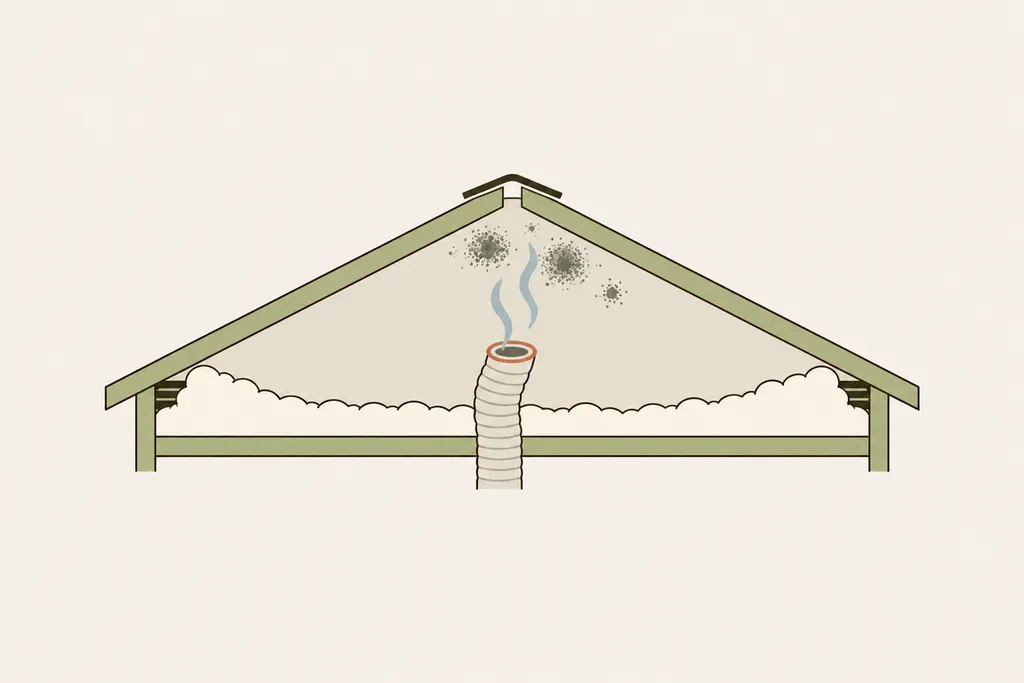
Two details are easy to miss. First, DOE calls venting into the attic “a major source of moisture” and says it is “quite common” to find fans and dryers doing it; it may also violate local building codes. PNNL adds that in many older homes the fan duct simply stops near an attic vent or lies on the attic floor. Second, more vents alone are not the whole answer: PNNL lists limiting air leakage from the house as one of the two main controls, together with proper intake and exhaust ventilation. Leaky heating or cooling ducts in the attic make air leakage worse.
What to do first, in order
- Leave the growth alone. Don’t scrape, spray or paint it. The EPA says not to paint over moldy surfaces and, when checking a problem, not to touch mold with bare hands or breathe it in.
- Look and take photos only if the attic hatch is easy and safe to reach. Photograph from the hatch opening where the growth is and how far it spreads — useful for contractors and, if it comes to that, your insurer. Don’t climb into the attic or touch anything. What to look for is on our signs of mold in attic page.
- Check the humidity in your living space. The EPA suggests keeping indoor relative humidity below 60%, ideally 30–50%, and says a humidity meter costs about $10–$50 at hardware stores. For winter in a cold climate, the Minnesota Department of Health suggests 20–40%.
- Have the moisture source confirmed. Where each fan duct really ends, whether the attic floor leaks air, and whether the roof leaks are things a pro can check. DOE suggests a home performance contractor for checking attic moisture.
- Fix the cause before or together with the cleanup. In the EPA’s words: “If you clean up the mold, but don’t fix the water problem, then, most likely, the mold problem will come back.”
If the stains are black and you’re wondering whether that color matters, see black mold in attic.
When to call a mold remediation professional
Based on EPA guidance, bring in a professional if any of these apply:
- The moldy area is larger than about 10 square feet (roughly 3 ft × 3 ft). The EPA says below that size a homeowner can, in most cases, handle the job; above it, the EPA points to its professional remediation guidance.
- The mold followed a flood, a sewage backup or other contaminated water.
- You suspect mold in the heating or cooling system or ducts. The EPA says not to run the system if you know or suspect it is contaminated.
- The mold is hidden — inside walls or other closed spaces, or you smell mold but can’t see it.
- Someone in the home has health concerns. The EPA advises talking to a health professional before cleanup starts.
Our suggestion for attics: attics are cramped and hard to reach, and finding the moisture source is part of the job, so we suggest leaving work there to a professional even for a small spot. That is our advice, not an EPA rule.
When you hire, the EPA suggests a contractor with mold cleanup experience and checked references, who follows the EPA’s remediation guidance or other professional guidelines. Our Mold Check tool walks through the same questions.
Fix the cause, not just the stain
The fix depends on the cause. The first four items are contractor work, separate from the mold cleanup:
- Exhaust ducts to the outdoors. PNNL says each bath or kitchen fan duct should end at a dampered roof cap or a vented opening in the soffit or side wall, be insulated, and have an air-sealed connection. It suggests a roofer for the vent in the roof or gable wall, and an HVAC technician or skilled handyman for routing the duct.
- Air sealing between the house and the attic. DOE says many homes lack enough air sealing between the top floor and the attic. The Minnesota Department of Health recommends insulating and sealing air leaks between attic and house to prevent ice dams. Ask a home performance or insulation contractor to assess and do this work.
- Roof and flashing repairs by a roofer. The EPA says the water problem must be completely fixed before a cleanup can be considered finished.
- Attic ventilation, assessed by a roofer or home performance contractor. DOE describes soffit (eave) vents paired with a ridge vent; PNNL says attic ventilation helps the roof deck dry out when condensation or a leak does happen.
- Your part: run fans while showering and cooking, as the EPA advises — once they actually vent outside.
Cost and insurance basics
This Old House (data mostly from Angi) lists attic mold removal at $1,000–$4,000: about $1,000 for a small spot in an easy-to-reach attic, up to $4,000 for extensive mold in a cramped one. If mold is in or behind the insulation, the insulation has to come out, which raises the price. Across all locations it gives $10–$25 per square foot. Repairs to damaged materials may be priced separately. See attic mold removal cost for the full breakdown.
On insurance, Triple-I says mold is generally treated as a home maintenance issue that standard homeowners policies don’t cover — but if the mold is the direct result of a covered peril such as a burst pipe, removal may be covered. Check your policy and ask your insurer; more in does homeowners insurance cover mold.
How serious is your mold? Take the Mold Check
Next step: get an on-site assessment from a licensed mold remediation professional.
Ask for a written scope that covers the moisture source, containment, removal, and how they will confirm the job is done.
Sources
- U.S. EPA — A Brief Guide to Mold, Moisture and Your Home (updated Feb 18, 2026)
- U.S. EPA — Mold Remediation in Schools and Commercial Buildings, Chapter 3 (updated Apr 29, 2026)
- U.S. Department of Energy — Guide to Durable Attics, DOE/EE-0339 (October 2010)
- PNNL Building America Solution Center (U.S. DOE) — Look at Exhaust Fans for Venting to Outside (updated Jul 25, 2025)
- PNNL Building America Solution Center (U.S. DOE) — Condensation Control in Attics and Roofs in Cold Weather (updated Dec 6, 2022)
- Minnesota Department of Health — Mold and Moisture in Homes (updated Feb 19, 2026)
- This Old House — How Much Does Mold Remediation Cost? (updated Mar 11, 2026; data mostly from Angi)
- Insurance Information Institute (Triple-I) — Protecting your home from mold (undated, read Oct 30, 2026)
Illustrations on this page are AI-generated to help you picture the situation. They are not photos of real homes, jobs or people.
Health and safety. Mold can affect health, especially for people with allergies, asthma, or weakened immune systems. This site does not give medical advice — for health concerns talk to a doctor. For mold removal, contact a licensed mold remediation professional (licensing rules vary by state).