Signs of Mold in Attic
Last reviewed 2026-10-30
The main signs of mold in an attic are spots or fuzzy growth on the underside of the roof sheathing and on rafters, a musty or earthy smell, wet or damp insulation, frost or water drops on the sheathing in cold weather, and darkened or water-stained patches in the insulation. The U.S. Department of Energy also lists clues you can see from outside: warped or rotted soffit and fascia boards, bubbled paint on the fascia, and worn or warped shingles at the roof edge. Each sign points to a different moisture source — and that source, not the stain, is what has to be fixed.
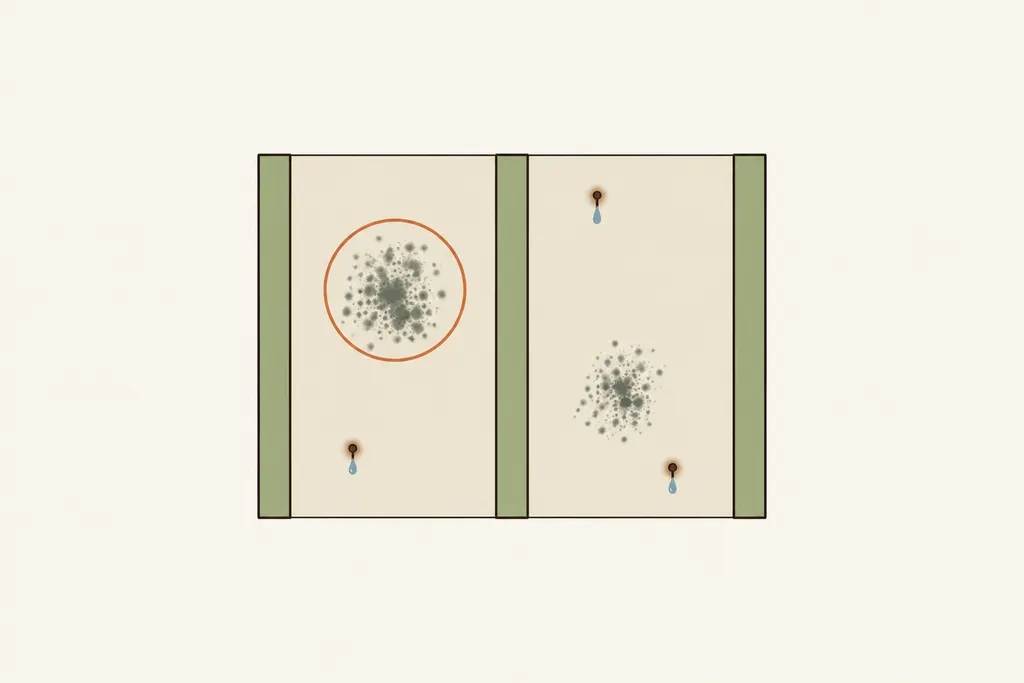
What each sign points to
| What you see | What it can point to | Source |
|---|---|---|
| Growth on the sheathing right above a bathroom or kitchen, or near a fan duct that ends in the attic | A fan venting moist air into the attic. PNNL shows exactly this: a bath fan duct blowing into the attic, with mold on the sheathing above | PNNL; DOE |
| Frost or water drops on the sheathing and rafters in cold weather | Warm, humid air from the house condensing on cold surfaces; it can drip onto the insulation and lead to mold or wood rot | Penn State PHRC; PNNL |
| Rusty nails or other metal fasteners; swollen sheathing or plywood with layers separating | Repeated condensation: PNNL says it can corrode metal fasteners and rot, swell or delaminate OSB and plywood | PNNL |
| Darkened (dirty-looking) patches in the insulation; frosty spots there in winter, water stains in the same spots in warmer weather | Air leaking up from the house — the insulation darkens as it filters dusty indoor air | ENERGY STAR |
| Wet or damp insulation | A roof leak, or warm air from below condensing on the cold roof | ENERGY STAR |
| Wet insulation near the eaves; warped or rotted soffit or fascia; bubbled fascia paint; worn shingles at the roof edge | DOE lists these as signs of possible water intrusion — for example, from roof leaks or ice dams | DOE |
| Damp wood or stains around a chimney or vent pipe | DOE lists badly installed flashing around chimneys and other roof penetrations as a way water enters | DOE |
| A musty smell but no visible growth | Hidden mold. The EPA says you may suspect hidden mold “if a building smells moldy, but you cannot see the source” | EPA |
| Watermarks on top-floor ceilings | Water coming through from above; Triple-I lists watermarks on walls and ceilings as signs to watch for | Triple-I |
ENERGY STAR also names a history of ice dams as a sign of serious air leaks. Our attic mold causes page explains how each source is fixed.
Mold or an old stain?
Mold doesn’t always look fuzzy. The Minnesota Department of Health says it can be cottony, velvety, granular or leathery, comes in white, gray, brown, black, green and other colors, and may look like plain discoloration or staining. Color alone doesn’t settle anything — see black mold in attic.
An old stain can also outlast the mold. The EPA notes that mold may cause staining and cosmetic damage, and that it may not be possible to restore an item’s original appearance after cleanup. So the more useful question is whether the wood is still getting wet. A contractor can check that with a moisture meter, which the EPA describes as a tool for measuring moisture in wood and other building materials.
Testing usually isn’t the first step. The EPA says that in most cases sampling is unnecessary if mold is visible, and the Minnesota Department of Health says testing “should never be a substitute for a good visual inspection.” Where sampling is used, the EPA says it can help tell mold from soot or dirt, and should be done by experienced professionals. More in mold testing cost.
How to look around your attic safely
You can spot several of these signs without going into the attic at all:
- From outside and below: soffits, fascia and roof edges (DOE), and watermarks on top-floor ceilings (Triple-I).
- From the attic hatch — only if it is easy and safe to reach: with a flashlight, look at the sheathing, rafters and the top of the insulation from the opening, and take photos for a contractor or your insurer. Don’t climb into the attic.
- Don’t touch anything. EPA safety tips for checking a mold problem: don’t touch mold with bare hands, don’t get it in your eyes, don’t breathe it in.
- Don’t disturb vermiculite insulation — a lightweight, pea-size, flaky gray mineral. ENERGY STAR warns it may contain asbestos and should be tested by an approved lab before anyone disturbs it.
Anything beyond a look from the hatch — going into the attic, moving insulation, opening up materials — is work for a professional. Attics are cramped and hard to reach, so we suggest leaving any work there to a pro even for a small spot; that is our advice, not an EPA rule.
When to call a professional
Based on EPA guidance, bring in a professional if any of these apply:
- The moldy area is larger than about 10 square feet (roughly 3 ft × 3 ft). The EPA says below that size a homeowner can, in most cases, handle the job; above it, the EPA points to its professional remediation guidance.
- The mold followed a flood, a sewage backup or other contaminated water.
- You suspect mold in the heating or cooling system or ducts. The EPA says not to run the system if you know or suspect it is contaminated.
- The mold is hidden — inside walls or other closed spaces, or you smell mold but can’t see it.
- Someone in the home has health concerns. The EPA advises talking to a health professional before cleanup starts.
Not sure where you stand? Our Mold Check tool asks the same questions and shows typical costs for your situation.
How serious is your mold? Take the Mold Check
Next step: get an on-site assessment from a licensed mold remediation professional.
Ask for a written scope that covers the moisture source, containment, removal, and how they will confirm the job is done.
Sources
- U.S. Department of Energy — Guide to Durable Attics, DOE/EE-0339 (October 2010)
- ENERGY STAR (U.S. EPA) — A Do-It-Yourself Guide to ENERGY STAR Home Sealing, EPA 430-F-04-024 (November 2004)
- PNNL Building America Solution Center (U.S. DOE) — Condensation Control in Attics and Roofs in Cold Weather (updated Dec 6, 2022)
- PNNL Building America Solution Center (U.S. DOE) — Look at Exhaust Fans for Venting to Outside (updated Jul 25, 2025)
- Penn State PHRC — Attic and Roof Ventilation: Facts and Fiction, webinar slides (March 12, 2013)
- Minnesota Department of Health — Mold and Moisture in Homes (updated Feb 19, 2026)
- U.S. EPA — A Brief Guide to Mold, Moisture and Your Home (updated Feb 18, 2026)
- U.S. EPA — Mold Remediation in Schools and Commercial Buildings, Chapter 3 (updated Apr 29, 2026)
- Insurance Information Institute (Triple-I) — Protecting your home from mold (undated, read Oct 30, 2026)
Illustrations on this page are AI-generated to help you picture the situation. They are not photos of real homes, jobs or people.
Health and safety. Mold can affect health, especially for people with allergies, asthma, or weakened immune systems. This site does not give medical advice — for health concerns talk to a doctor. For mold removal, contact a licensed mold remediation professional (licensing rules vary by state).