White Mold in Basement or Crawl Space — or Efflorescence?
Last reviewed 2026-10-30
White growth in a basement or crawl space can be mold or mineral salt, and the two can look alike. The EPA’s rule of thumb: “Alkaline crystals on soil or concrete walls may look like mold, but, unlike mold, they are usually water-soluble.” Salt deposits on concrete or block — called efflorescence — are not mold, but they are a sign that water is moving through the foundation. White fuzz on wood, drywall, cardboard or other organic material is more likely mold. Either way the cause is moisture. For mold over about 10 square feet, and for any mold in a crawl space, we suggest a mold remediation professional.
White mold or efflorescence? How to tell
Mold comes in many colors, and white is one of them, the EPA notes. Efflorescence is salt that water carries out of masonry: the National Park Service explains that excess moisture can carry soluble salts through masonry walls, and when the water reaches the surface and evaporates, the salts may appear as efflorescence, “a whitish powder.” (The Park Service counts concrete and concrete block as masonry.) In the EPA’s foundation checklist, efflorescence is listed among the signs of water seeping or wicking through the foundation.
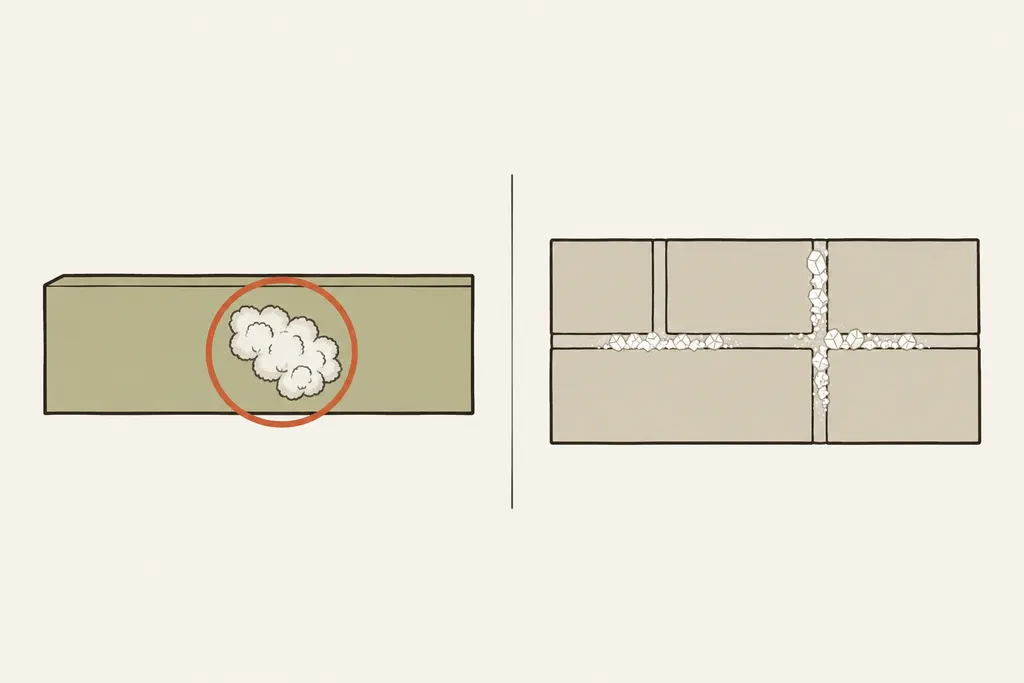
| Clue | Points to efflorescence (mineral salt) | Points to mold |
|---|---|---|
| Water | Usually dissolves in water (EPA) | Does not dissolve (EPA: “unlike mold”) |
| What it’s on | Concrete walls; also crawl space soil (EPA) | Organic material — the EPA lists paper, cloth, wood, plant material and soil |
| Look | Crystals (EPA: “alkaline crystals”) or a whitish powder (National Park Service); on crawl space soil it can look fibrous (EPA) | Cottony, velvety, granular or leathery (Minnesota Department of Health) |
| Smell | — | Mold odors are described as “musty or earthly” (Minnesota Department of Health) |
The table gives clues for you and a professional, not a test to try on a spot that may be mold. The EPA’s foundation checklist lists efflorescence and mold growth side by side as signs of seepage, so you can find both in the same basement. If you can’t tell, don’t scrape, brush or sand the spot to find out. The EPA notes that most microbiology labs can tell whether something is mold from a small amount on a strip of clear sticky tape, and it advises people without experience to consult an experienced professional for sampling.
In crawl spaces the EPA gives a specific example: “A white, soluble fibrous material on the soil of the crawl space may be alkaline salts, not mold, indicating moisture has been a problem and suggesting that the area should be more extensively inspected.” In other words, even when it’s salt, it’s a reason to look further.
Wondering whether a flat white or gray patch is “just mildew”? The EPA’s mold course says molds are “also called fungi or mildew,” so it’s still mold — more in mold vs mildew.
Why it grows in basements and crawl spaces
Both spaces sit against the soil. The EPA explains that crawl spaces with high humidity “are common sites of hidden mold growth, particularly if the crawl space has a bare earth floor”: the soil wicks moisture, the crawl space’s warmth evaporates it into the air, and where the water table is high, groundwater can enter. That moisture doesn’t stay put — the EPA says it can move into the rest of the house through cracks in walls, floors and ceilings.
Basements get wet the same ways plus a few more: plumbing leaks, rain and groundwater around the foundation, and condensation on walls that are cooler than the outdoor air in warm weather. The full list is in mold in basement.
Mold that looks white isn’t one kind. Fixr notes that “white mold” refers to many species that grow in homes, including Aspergillus, Cladosporium and Penicillium, and that some of them look white early on and change color after producing spores.
Where to look
- Concrete and block walls, basement floors. White crust or powder here can be efflorescence; the EPA names concrete walls as a place where alkaline crystals can be mistaken for mold.
- Crawl space soil. The EPA’s example above — white fibrous material that may be salts.
- Wood and paper. Framing, the paper facing of drywall, stored cardboard. Mold needs food, and the EPA lists paper, wood and cloth among the organic materials it uses.
- Hidden spots. The EPA lists damp areas in crawl spaces and behind walls among the places mold hides. A musty smell without visible growth is covered in musty smell in basement.
When it needs professional removal
Efflorescence itself isn’t mold, so it doesn’t need mold remediation — but the moisture it points to needs a look. Mold is different.
Call a mold remediation professional when:
- the mold covers more than about 10 square feet — below that, the EPA says that in most cases a homeowner can handle it;
- it followed a flood, a sewage backup or other contaminated water — the EPA says to call in a professional with experience cleaning buildings damaged by contaminated water;
- you suspect mold in the furnace, air conditioner or ducts — the EPA says not to run the HVAC system if you know or suspect it is contaminated, because it could spread mold through the building;
- the mold is inside walls or hidden — for example, a musty smell with no visible growth;
- someone in the home has health concerns — the EPA says to consult a health professional before cleanup starts.
Our own advice goes further than the EPA’s 10-square-foot line: leave mold in a crawl space to a professional whatever its size, and the Mold Check gives the same answer. Access can be limited — This Old House notes the cost “can be much higher for limited-access crawl spaces” — and the EPA explains that the soil and air there are part of the moisture problem.
Fixing the moisture source
White salt or white mold, the fix starts with the water. The EPA warns that if you clean up mold “but don’t fix the water problem, then, most likely, the mold problem will come back,” and recommends keeping indoor humidity below 60 percent, ideally 30–50 percent. For crawl spaces, the EPA’s mold course says they “should be designed specifically to avoid moisture problems” — a question for a contractor who works on crawl spaces, not a weekend project.
| This Old House (2026) | Fixr (2025) | |
|---|---|---|
| Basement mold removal | $500–$3,000 | $1,500–$4,000 |
| Crawl space mold removal | $500–$2,000 | $500–$2,000 |
The two guides use different data; use them to sanity-check quotes. What a crawl space job usually includes and costs is covered in crawl space mold removal cost.
How serious is your mold? Take the Mold Check
Next step: get an on-site assessment from a licensed mold remediation professional.
Ask for a written scope that covers the moisture source, containment, removal, and how they will confirm the job is done.
Sources
- U.S. EPA — Mold Course, Chapter 3: Finding Mold and Moisture (last updated Dec 1, 2025)
- U.S. EPA — Mold Course, Chapter 1: Introduction to Molds (last updated Feb 18, 2026)
- U.S. EPA — Mold Course, Chapter 2: Why and Where Mold Grows (last updated Dec 1, 2025)
- U.S. EPA — Moisture Control Guidance for Building Design, Construction and Maintenance (EPA 402-F-13053, Dec 2013; Foundation Maintenance checklist, p. 92)
- U.S. National Park Service — Preservation Brief 1: Assessing Cleaning and Water-Repellent Treatments for Historic Masonry Buildings (Nov 2000)
- Minnesota Department of Health — Mold and Moisture (last updated Feb 19, 2026)
- U.S. EPA — A Brief Guide to Mold, Moisture and Your Home (last updated Feb 18, 2026)
- This Old House — Mold Remediation Cost (updated Mar 11, 2026; data mostly from Angi)
- Fixr — Mold Remediation Cost (updated Aug 29, 2025)
Illustrations on this page are AI-generated to help you picture the situation. They are not photos of real homes, jobs or people.
Health and safety. Mold can affect health, especially for people with allergies, asthma, or weakened immune systems. This site does not give medical advice — for health concerns talk to a doctor. For mold removal, contact a licensed mold remediation professional (licensing rules vary by state).