Mold vs Mildew: What's the Difference?
Last reviewed 2026-10-30
Mildew isn’t a separate thing from mold. The U.S. EPA says “mildew refers to certain kinds of mold or fungus” and that the word is “often used generically to refer to mold growth, usually with a flat growth habit.” So in everyday use, “mildew” means the flat growth on damp surfaces like shower walls and windowsills, and “mold” covers all of it, including growth that works into drywall, carpet and wood. What you call it matters less than three questions: what surface it’s on, how big the area is, and where the moisture comes from. Those decide whether it’s a quick bathroom fix or a job for a professional.
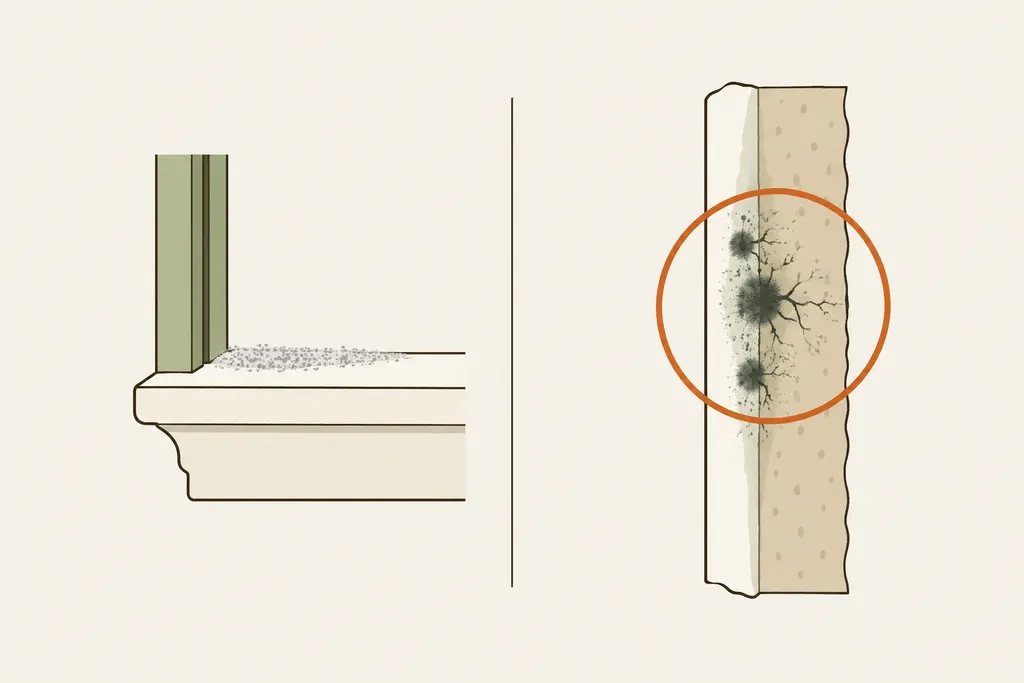
Mold vs mildew at a glance
| “Mildew” (as people use the word) | Mold (the broader group) | |
|---|---|---|
| What it is | “Certain kinds of mold or fungus” (EPA) | Microscopic fungi that grow as thread-like filaments called hyphae (EPA) |
| Typical growth | Usually flat (EPA) | Can grow on or fill the spaces and crevices of porous materials (EPA) |
| Where you see it | Shower walls, windowsills and other places where moisture levels are high (EPA) | Any organic matter, including clothing, leather, paper, and the ceilings, walls and floors of homes with moisture problems (EPA) |
| What it needs | Moisture | Moisture |
The EPA’s mold course puts it the same way: molds are “also called fungi or mildew.” Texas’s mold licensing agency, TDLR, adds one practical line: “If mildew appears, that means there is a moisture problem.”
Can you tell them apart by look?
Not reliably. Popular descriptions of mildew don’t even agree with each other:
| Source | How it describes mildew | How it describes mold |
|---|---|---|
| University of Rhode Island housing office (2025) | White, gray or yellow; feels powdery | Black, green or fuzzy |
| UF/IFAS Extension fact sheet (2005, archival) | “Musty odor and black fuzzy discoloration,” also brownish or reddish | — |
| TDLR (Texas) | People use the name for “small black spots of fungus” on damp surfaces | — |
| CDC | — | “Spots of many different colors,” can “smell musty” |
| EPA mold course | — | “Molds come in many colors including white.” |
Color and texture are a rough clue, not an identification. You usually don’t need a lab to settle it, either: the EPA says that “in most cases, if visible mold growth is present, sampling is unnecessary.” If you’re weighing a test anyway, see what mold testing costs and what it can and can’t tell you.
Where each one shows up in a home
The flat surface growth people call mildew tends to appear where water sits briefly and often: shower walls and windowsills (EPA), bathrooms and damp clothing (UF/IFAS).
Mold is the term to keep in mind for the places you can’t easily see. The EPA lists hidden spots such as the back side of drywall, wallpaper or paneling, the top of ceiling tiles, the underside of carpets and pads, walls around leaking or condensing pipes, and inside ductwork. A smell can be the first clue: the EPA says “a moldy odor suggests that mold is growing in the building and should be investigated.” In unaired places like basements, molds “can produce a strong musty odor” — more on that in musty smell in the basement.
Why the surface matters more than the name
Hard, non-porous surfaces are where the flat growth people call “mildew” is usually seen — shower walls and windowsills, in the EPA’s examples. For a bathroom spot that keeps coming back, the EPA says increasing ventilation (running a fan or opening a window) and cleaning more often “will usually prevent mold from recurring, or at least keep the mold to a minimum.”
Porous materials are a different story. The EPA says absorbent materials “such as ceiling tiles and carpet, may have to be thrown away if they become moldy,” because mold can fill their spaces and crevices and “may be difficult or impossible to remove completely.” This Old House notes that mold in porous materials like drywall, insulation or carpet “often requires full removal and replacement,” which raises labor and material costs.
Either way, the water comes first. The EPA: “If you clean up the mold, but don’t fix the water problem, then, most likely, the mold problem will come back.”
For scale: This Old House (data mostly from Angi) puts bathroom mold removal at $500–$1,000 and the average professional job at about $2,300. See mold remediation cost for the full breakdown.
When to call a mold remediation professional
The EPA says that if the moldy area is less than about 10 square feet (roughly 3 ft by 3 ft), “in most cases, you can handle the job yourself” — see the EPA’s guide for its conditions. Call a professional instead when:
- The moldy area is larger than about 10 square feet, or there has been a lot of water damage. For either, the EPA points to its guide Mold Remediation in Schools and Commercial Buildings, which it says “is applicable to other building types.”
- The water came from a flood, sewage or other contaminated water. The EPA says to call in a professional who has experience with buildings damaged by contaminated water.
- You suspect mold in the heating or cooling system. The EPA says not to run the HVAC system if you know or suspect it is contaminated, because it could spread mold through the house. Leave it off until it’s checked.
- The mold is inside walls or hidden — for example, a musty smell with no visible source. The EPA warns that disturbing hidden growth — even peeling back wallpaper — can release a large number of spores, and suggests considering an experienced professional.
- Someone in the home has health concerns. Talk to a doctor first; the EPA says to consult a health professional before starting cleanup.
Not sure which side you’re on? The Mold Check asks five questions and gives you a plain answer plus typical costs.
Preventing both
Mold and mildew need the same thing — moisture — so prevention is identical:
- Keep humidity down. The EPA recommends keeping indoor humidity below 60%, ideally 30–50%, and notes a humidity meter costs about $10–$50. The CDC says to keep it as low as you can, “no higher than 50%.”
- Dry leaks and spills fast. The EPA says that if wet materials are dried within 24–48 hours, in most cases mold will not grow.
- Vent moisture out. Run the bathroom fan or open a window when showering, and use exhaust fans when cooking or running the dishwasher (EPA).
- Fix the source. Plumbing leaks, roof leaks and condensation on cold pipes all feed both.
How serious is your mold? Take the Mold Check
Next step: get an on-site assessment from a licensed mold remediation professional.
Ask for a written scope that covers the moisture source, containment, removal, and how they will confirm the job is done.
Sources
- U.S. EPA — What is the difference between mold and mildew? (last updated Jun 23, 2026)
- U.S. EPA — Mold Course, Chapter 1: Introduction to Molds (last updated Feb 18, 2026)
- U.S. EPA — A Brief Guide to Mold, Moisture and Your Home (last updated Feb 18, 2026)
- U.S. EPA — What does mold smell like? (last updated Sep 8, 2026)
- CDC — Mold Basics (page dated Sep 26, 2024)
- Texas Department of Licensing and Regulation — Mold Assessors and Remediators FAQ (no date shown; accessed Oct 30, 2026)
- UF/IFAS Extension — Keeping it Clean: Controlling Mildew, FCS5232-11/FY796 (2002, revised Nov 2005; archival copy)
- University of Rhode Island, Housing & Residential Life — Mold vs. Mildew: What's the Difference? (Feb 21, 2025)
- This Old House — Mold Remediation Cost (updated Mar 11, 2026; data mostly from Angi)
Illustrations on this page are AI-generated to help you picture the situation. They are not photos of real homes, jobs or people.
Health and safety. Mold can affect health, especially for people with allergies, asthma, or weakened immune systems. This site does not give medical advice — for health concerns talk to a doctor. For mold removal, contact a licensed mold remediation professional (licensing rules vary by state).