Mold Under Carpet: Signs, Causes and When to Replace It
Last reviewed 2026-10-30
Mold under carpet starts with water or moisture: a leak, an overflow or a flood that soaked the carpet and pad and didn’t dry fast enough, or a damp basement or bathroom. The EPA lists “the underside of carpets and pads” among the usual places for hidden mold, and one common clue is a musty smell in a room that once got wet. Once carpet is moldy, the EPA says absorbent materials like carpet “may have to be thrown away,” and the floor underneath has to be dried too. If the moldy area is bigger than about 10 square feet, there has been a lot of water damage, or the water was from a flood or sewage, this is a job for a water damage or mold professional.
Signs of mold under carpet
- A musty smell you can’t trace. The EPA says “a moldy odor suggests that mold is growing in the building and should be investigated.”
- A known water event in that room: a burst or leaking pipe, an appliance overflow, a roof or window leak, or flood water. This Old House lists recent water damage among the signs that you need mold remediation.
- Carpet that stays damp or feels wet underfoot well after the leak.
- Visible spots or water stains on the carpet or nearby walls, which This Old House lists among common signs of mold in a home.
The EPA says you may suspect hidden mold “if a building smells moldy, but you cannot see the source.”
If you suspect mold, don’t pull the carpet up to look. The EPA warns that investigating hidden mold “will require caution when the investigation involves disturbing potential sites of mold growth,” because disturbing it can release spores, and suggests considering an experienced professional. Things you can do without disturbing anything: limit who goes into the room, measure the humidity with an inexpensive meter (the EPA puts them at about $10–$50), and take photos for your records and your insurer.
Why mold grows under carpet
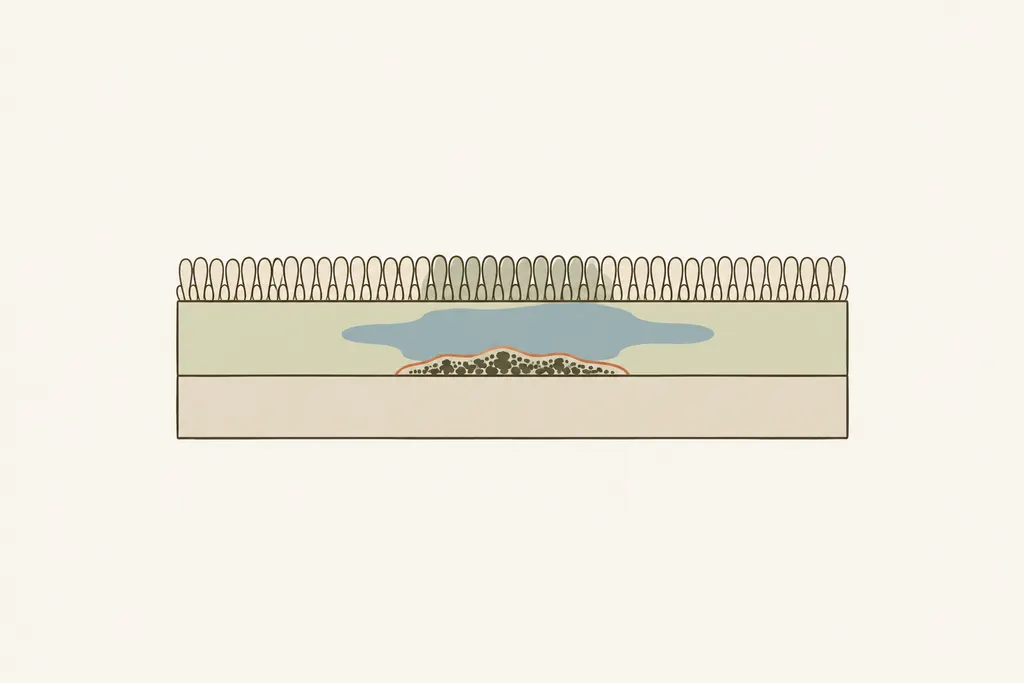
A carpeted floor is several layers: the carpet and its backing, the pad, and the subfloor. Water that soaks through can sit in the pad and against the subfloor, out of sight. EPA guidance names “molds that can grow on wood, paper, carpet, foods, and insulation,” and its water damage table notes that “the subfloor under the carpet or other flooring material must also be cleaned and dried.”
How fast does it happen? The sources put it slightly differently, so here they are side by side:
| Source | What it says about timing |
|---|---|
| EPA, Brief Guide | If wet materials are dried within 24–48 hours of a leak or spill, “in most cases mold will not grow.” |
| EPA, water damage table | “Even if materials are dried within 48 hours, mold growth may have occurred,” and mold “will not always occur after 48 hours; this is only a guideline.” |
| EPA, flood cleanup | “When things remain wet for more than two days, they usually get moldy.” |
| Texas Department of Insurance | “Mold can start growing within a day after a leak.” |
The CDC advises against carpet “in places like bathrooms or basements that may have a lot of moisture,” and This Old House notes that carpeting in basements or bathrooms “can trap moisture, creating hidden mold problems beneath.” If your carpet is in a basement, see mold in the basement and musty smell in the basement for where that moisture usually comes from.
Can moldy carpet be saved?
Official and industry sources lean toward replacing it, especially anything that became moldy or couldn’t be dried quickly:
| Situation | What the sources say |
|---|---|
| Carpet that has become moldy | EPA: absorbent materials such as carpet “may have to be thrown away if they become moldy,” because mold “may be difficult or impossible to remove completely.” TDLR (Texas): mold “is difficult to clean from absorbent (porous) surfaces such as drywall, carpet” and such materials “should be removed and discarded.” |
| Carpet and pad soaked in a flood | Triple-I: dry or remove soaked carpets and padding within 24–48 hours; “anything that can’t be properly dried should be discarded and replaced.” CDC: “Remove or replace carpets and upholstery that have been soaked and cannot be dried right away.” |
| Water from sewage or other contaminated sources | EPA: its drying guidance is for clean water; with sewage or contaminated water, OSHA requires protective equipment and containment, and an experienced professional should be consulted. |
This Old House adds the cost side: mold in porous materials like carpet “often requires full removal and replacement,” and disposal fees may apply for carpeting depending on where you live.
When to call a water damage or mold professional
The EPA says that if the moldy area is less than about 10 square feet (roughly 3 ft by 3 ft), “in most cases, you can handle the job yourself” — see the EPA’s guide for its conditions. Call a professional when:
- The moldy area is larger than about 10 square feet, or there has been a lot of water damage. For either, the EPA points to its guide Mold Remediation in Schools and Commercial Buildings, which it says “is applicable to other building types.”
- The water came from a flood, sewage or other contaminated water. The EPA says to call in a professional experienced with contaminated water.
- You suspect mold in the heating or cooling system. The EPA says not to run the HVAC system if you know or suspect it is contaminated; leave it off until it’s checked.
- The mold is hidden — under the pad, in the subfloor or in the walls next to the wet area, for example, a smell with no visible source.
- Someone in the home has health concerns. Talk to a doctor first; the EPA says to consult a health professional before starting cleanup.
If the leak is recent and the carpet is still wet, drying it fast is the priority. The Texas Department of Insurance says that if you can’t remove the water and dry the area yourself, use a business that specializes in cleaning up after water damage. The Mold Check can help you size up the situation.
Cost and insurance notes
This Old House (data mostly from Angi) puts professional mold removal at about $500–$1,250 for roughly 50 sq ft, $1,000–$2,500 for 100 sq ft and $2,000–$5,000 for 200 sq ft. That’s remediation; new carpet and pad may not be included, so ask what the quote covers. More detail in mold remediation cost.
If a sudden leak caused the damage, your homeowners policy may be involved. The Texas Department of Insurance advises taking pictures or videos before repairs and not throwing away damaged items until your adjuster has seen them. Whether mold is covered depends on the cause and your policy — see does homeowners insurance cover mold? and ask your insurer.
Preventing mold under flooring
- Dry leaks and spills within 24–48 hours (EPA), including the pad and the subfloor.
- Keep humidity down: the EPA recommends below 60%, ideally 30–50%; the CDC says “no higher than 50%.”
- Think twice about carpet in damp rooms such as bathrooms and basements (CDC).
- Fix the source of the water or moisture, or the mold can come back (EPA).
How serious is your mold? Take the Mold Check
Next step: get an on-site assessment from a licensed mold remediation professional.
Ask for a written scope that covers the moisture source, containment, removal, and how they will confirm the job is done.
Sources
- U.S. EPA — A Brief Guide to Mold, Moisture and Your Home (last updated Feb 18, 2026)
- U.S. EPA — Mold Remediation in Schools and Commercial Buildings, Chapter 1 (last updated Feb 18, 2026)
- U.S. EPA — Mold Remediation in Schools and Commercial Buildings, Chapter 3 (last updated Apr 29, 2026)
- U.S. EPA — Mold Remediation in Schools and Commercial Buildings, Chapter 4: Table 1, Water Damage (last updated Sep 8, 2026)
- U.S. EPA — Resources for Flood Cleanup and Indoor Air Quality (last updated Sep 2, 2026)
- U.S. EPA — What does mold smell like? (last updated Sep 8, 2026)
- CDC — Mold Basics (page dated Sep 26, 2024)
- Triple-I (Insurance Information Institute) — Protecting your home from mold (no date shown; accessed Oct 30, 2026)
- Texas Department of Insurance — When are water damage and mold covered by insurance? (last updated Apr 24, 2025)
- Texas Department of Licensing and Regulation — Mold Assessors and Remediators FAQ (no date shown; accessed Oct 30, 2026)
- This Old House — Mold Remediation Cost (updated Mar 11, 2026; data mostly from Angi)
Illustrations on this page are AI-generated to help you picture the situation. They are not photos of real homes, jobs or people.
Health and safety. Mold can affect health, especially for people with allergies, asthma, or weakened immune systems. This site does not give medical advice — for health concerns talk to a doctor. For mold removal, contact a licensed mold remediation professional (licensing rules vary by state).