Mold in Walls: Signs and Removal
Last reviewed 2026-10-30
Mold inside a wall is out of sight, so you go by indirect signs: a musty smell with no visible source, a leak or water damage nearby, water stains, and paint or wallpaper that bubbles, peels or discolors. The EPA says you may suspect hidden mold “if a building smells moldy, but you cannot see the source,” and This Old House lists recent water damage among the signs that call for mold removal. Removal means fixing the water source first, then cutting out and replacing moldy drywall and insulation — porous materials that the EPA says can be difficult or impossible to clean completely. Because opening a moldy wall can release a lot of spores, the EPA suggests hiring an experienced professional when you suspect hidden mold.
Signs of mold inside a wall
- A musty or earthy smell you can’t trace — the EPA’s main pointer to hidden mold.
- A known leak or recent water damage on or near the wall (This Old House; Minnesota Department of Health): a plumbing leak, a roof or window leak, or past flooding.
- Water stains or watermarks on the wall or ceiling (Minnesota Department of Health; Triple-I).
- Bubbling, peeling, warped or discolored paint or wallpaper (This Old House).
- Spots, speckles or fuzzy patches on the wall surface (This Old House), including behind furniture, where the EPA says condensation can form.
- Condensation on windows and exterior walls (Minnesota Department of Health).
A clean-looking wall doesn’t rule mold out. The EPA notes that mold may be hidden on the back side of drywall, wallpaper or paneling, and its guide shows a photo of mold growing on the back side of wallpaper.
Where the moisture comes from
Mold needs water, so the question is what is wetting the wall:
- Leaking or sweating pipes inside the wall. The EPA names “areas inside walls around pipes (with leaking or condensing pipes)” as a place hidden mold grows.
- Leaks from outside through the roof, walls, windows or floors (Florida Department of Health; Triple-I).
- Condensation on cold exterior walls, especially behind furniture where air doesn’t move (EPA; Minnesota Department of Health).
- Water trapped under wall finishes. The EPA says vinyl wallpaper over drywall or wood paneling can act as a vapor barrier, trapping moisture underneath.
- Sprinkler spray on outside walls, overflowing fixtures, poorly vented bathrooms and kitchens, and flooding (Florida Department of Health).
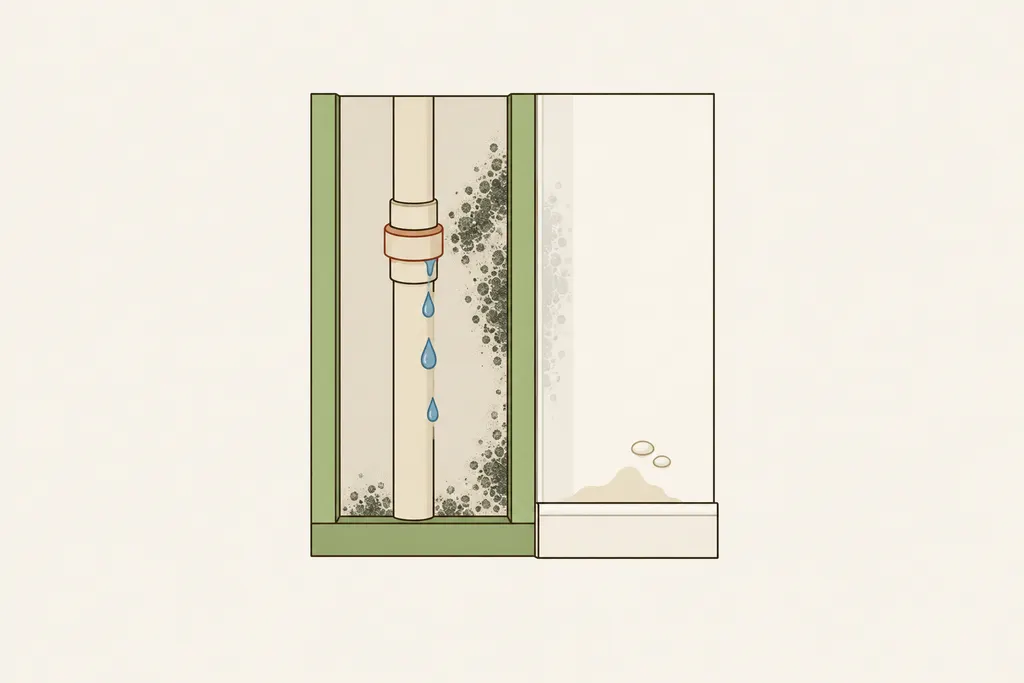
Why you shouldn’t open the wall to look
The EPA warns that investigating hidden mold “may be difficult and will require caution when the investigation involves disturbing potential sites of mold growth.” Its example: removing wallpaper “can lead to a massive release of spores” if mold is growing on the back. It also lists breaking up moldy wallboard and invasive work inside a wall cavity among the actions likely to stir up mold. The EPA’s advice: “If you believe that you may have a hidden mold problem, consider hiring an experienced professional.”
What you can do safely: note where the smell is strongest, photograph stains and damaged paint, and keep a record of any leaks — useful for a contractor and for your insurer.
How professionals find hidden mold
According to the Minnesota Department of Health, indoor air quality professionals may use moisture meters, scoping cameras and infrared cameras. The EPA describes moisture meters as tools that measure moisture in wallboard, wood and other materials and track drying after water damage.
Lab sampling is a separate step. The EPA says it is unnecessary in most cases when mold is visible, may help locate the source, and should be done by experienced professionals; there are no federal limits to compare results against. See mold inspection cost and mold testing cost.
How mold is removed from walls
This is professional work; here’s what a quote should cover:
- Fix the water first. The EPA says mold will most likely come back if the water problem isn’t fixed.
- Contain the work area. EPA guidance generally recommends limited containment (plastic sheeting around the area) for roughly 10–100 square feet of mold and full containment, with an airlock, above 100 square feet. The guide was written for schools and commercial buildings, but the EPA says it applies to other building types too.
- Remove porous materials. The Minnesota Department of Health says moldy drywall and insulation should be bagged and thrown away. Brian Fitzsimons, an environmental contractor, put it this way on This Old House: “You can’t really clean mold off drywall. You have to completely remove it from the house.”
- Clean up with HEPA vacuums after materials are removed and dried (EPA).
- Rebuild only when it’s dry. Minnesota’s health department says rebuilding waits until the area is completely dry, which may take “several days, weeks or even months.”
When hiring, the EPA suggests a contractor with mold cleanup experience and checked references, who follows its remediation guidance. Licensing rules vary by state: the Florida Department of Health (page updated March 2026) notes that Florida’s Department of Business and Professional Regulation licenses mold assessors and remediators under sections 468.84–468.8424 of the Florida Statutes, while the Minnesota Department of Health (February 2026) says neither Minnesota nor any federal agency licenses them.
When to call a mold remediation professional
Based on EPA guidance, bring in a professional if any of these apply:
- The moldy area is larger than about 10 square feet (roughly 3 ft × 3 ft). The EPA says below that size a homeowner can, in most cases, handle the job; above it, the EPA points to its professional remediation guidance.
- The mold followed a flood, a sewage backup or other contaminated water.
- You suspect mold in the heating or cooling system or ducts. The EPA says not to run the system if you know or suspect it is contaminated.
- The mold is hidden — inside walls or other closed spaces, or you smell mold but can’t see it.
- Someone in the home has health concerns. The EPA advises talking to a health professional before cleanup starts.
Our Mold Check tool asks the same questions and shows typical costs.
Cost and insurance basics
This Old House (data mostly from Angi) puts professional mold remediation at $10–$25 per square foot, about $18 on average:
| Affected area | Typical cost |
|---|---|
| About 50 sq ft | $500–$1,250 |
| About 100 sq ft | $1,000–$2,500 |
| About 200 sq ft | $2,000–$5,000 |
| About 500 sq ft | $5,000–$12,500 |
This Old House notes that untreated hidden mold may spread into wood framing and require structural repairs, and that rebuilding drywall, framing or cabinetry is often priced separately from remediation. More in mold remediation cost.
On insurance, Triple-I says mold is generally treated as a maintenance issue that standard homeowners policies don’t cover, but if it is the direct result of a covered peril such as a burst pipe, removal may be covered. Check your policy and ask your insurer; see does homeowners insurance cover mold.
Preventing mold inside walls
From the EPA’s moisture-control advice:
- Have plumbing leaks fixed as soon as possible, and dry wet materials within 24–48 hours — in most cases mold won’t grow if they’re dried that fast.
- Keep indoor humidity below 60%, ideally 30–50%; a humidity meter costs about $10–$50.
- Have cold water pipes insulated to stop condensation.
- Vent clothes dryers outdoors, and run bathroom and kitchen fans.
How serious is your mold? Take the Mold Check
Next step: get an on-site assessment from a licensed mold remediation professional.
Ask for a written scope that covers the moisture source, containment, removal, and how they will confirm the job is done.
Sources
- U.S. EPA — A Brief Guide to Mold, Moisture and Your Home (updated Feb 18, 2026)
- U.S. EPA — Mold Remediation in Schools and Commercial Buildings, Chapter 3 (updated Apr 29, 2026)
- Minnesota Department of Health — Mold and Moisture in Homes (updated Feb 19, 2026)
- Florida Department of Health — Mold (updated Mar 25, 2026)
- This Old House — How Much Does Mold Remediation Cost? (updated Mar 11, 2026; data mostly from Angi)
- Insurance Information Institute (Triple-I) — Protecting your home from mold (undated, read Oct 30, 2026)
Illustrations on this page are AI-generated to help you picture the situation. They are not photos of real homes, jobs or people.
Health and safety. Mold can affect health, especially for people with allergies, asthma, or weakened immune systems. This site does not give medical advice — for health concerns talk to a doctor. For mold removal, contact a licensed mold remediation professional (licensing rules vary by state).